
SRES Expands from 100 kW to 1 MW: The Commercial Solar Rebate
By The Energus Team
There’s never been a better time to invest in commercial and industrial solar in Australia. Why? From 1 October 2026, the Small-scale Renewable Energy Scheme (SRES) will be expanded from 100 kW to 1 MW (Source: DCCEEW), and this move continues to pave the way for Australia’s smart energy future.
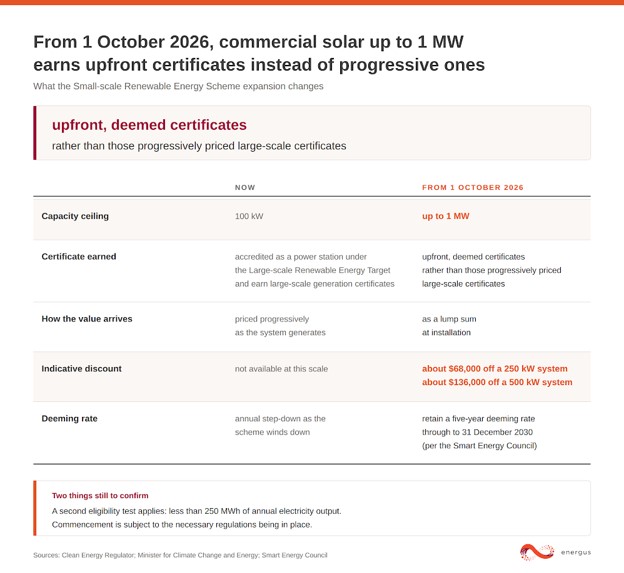
As stated in the official media release, the federal government estimates that the change will cut upfront costs by about 20 per cent, equating to roughly $68,000 on a 250 kW system and $136,000 on a 500 kW system.
So, what changes are being made, and what do they mean for commercial and industrial solar? Let’s take a look.
Examining Changes to the Small-scale Renewable Energy Scheme
First introduced in 2011, the Small-scale Renewable Energy Scheme (SRES) is an initiative provided by the Australian Government. Under this scheme, the government has traditionally offered upfront discounts on small-scale renewable energy systems in exchange for the certificates that system earns.
Until now, it was capped at 100 kW of solar photovoltaic capacity (usually shortened to solar PV), which is roughly the front third of a mid-sized warehouse roof (Source: Clean Energy Regulator). By October, this will have changed.
The scheme itself will remain in place. The new ceiling, however, will move to cover solar systems with a capacity of up to 1 MW. A key driver of this decision was to address ‘the missing middle’ identified in a landmark report by the Smart Energy Council.
This was highlighted by Minister Bowen himself when he noted that “one in three Australian homes have rooftop solar, but larger energy users have been locked out because the existing solar rebate only supports systems up to 100 kW (Source: DCCEEW).
The SRES Scheme: Current vs Proposed
The Australian Government has announced an expansion of the Small-scale Renewable Energy Scheme (SRES), but the detailed rules are still subject to regulations. Here is what is currently known:
Current SRES
Eligibility: The SRES currently covers eligible solar systems up to 100 kW.
Incentive: Eligible systems can generate Small-scale Technology Certificates (STCs).
How the incentive works: STCs represent the expected renewable energy generation of an eligible system and are generally assigned to a registered agent in exchange for an upfront discount.
Larger systems: Solar systems above the current 100 kW SRES threshold may instead be eligible for the Large-scale Renewable Energy Target and Large-scale Generation Certificates (LGCs), subject to the relevant requirements.
Proposed SRES expansion
Eligibility: The SRES eligibility limit is expected to increase from 100 kW to 1 MW.
Start date: The expanded scheme is expected to commence on 1 October 2026, subject to the necessary regulations being in place.
Who could benefit: The expansion is intended to support businesses, farms and community organisations with larger rooftop solar systems.
Upfront cost: The government estimates that the expansion could reduce upfront installation costs by around 20% for eligible mid-sized solar projects.
Certificate arrangements: The expansion will use the existing SRES framework, but the detailed rules for how certificates will be calculated and applied to systems in the expanded size range are still to be confirmed through regulations.
What Does the New Cap Pay on a 250 kW or 500 kW Installation?
The government has published its own working figures along with the announcement. In these figures, the estimated discount is approximately $68,000 off a 250 kW system, and about $136,000 off a 500 kW system, described as enough to power a small manufacturing site.
Here is a breakdown of the potential savings on offer once the new changes take effect.
| System size | Approximate STCs, 2026 install | Indicative certificate value | Annual generation | Annual bill saving |
| 250 kW | ~1,727 | ~$68,000 | ~345 MWh | ~$50,000 |
| 500 kW | ~3,455 | ~$136,000 | ~730 MWh | ~$102,000 |
| 850 kW | ~5,873 | ~$230,000 | ~1,173 MWh | ~$175,000 |
What Will the Move to Upfront STCs Mean for Commercial Solar?
Under the current rules, commercial solar systems above 100 kW generally sit outside the small-scale scheme and may instead be eligible for Large-scale Generation Certificates (LGCs). LGCs are created as the system generates electricity, providing an ongoing source of certificate revenue rather than an upfront discount.
From 1 October 2026, eligible new solar installations and expansions of existing systems up to 1 MW are expected to become eligible for upfront Small-scale Technology Certificates (STCs). Instead of receiving certificate revenue progressively as electricity is generated, businesses can receive the value of the deemed certificates upfront, reducing the initial cost of the solar installation.
The Smart Energy Council has indicated that eligible systems could retain a five-year deeming period through to the end of 2030 (Source: SEC), but this should not be treated as final until the relevant rules are published.
What the SRES Changes Mean for Commercial and Industrial Solar Projects
The proposed increase from 100 kW to 1 MW could be particularly valuable for the types of large commercial and industrial sites we support.
At Energus, we’ve designed and installed solar systems for warehouses, logistics facilities, manufacturing and food processing sites, transport facilities, automotive businesses, schools, healthcare facilities, leisure centres and government buildings. These sites often have large roof areas and significant daytime electricity demand, making them well suited to larger-scale solar systems.
The proposed change could allow businesses that previously had to stay below the 100 kW SRES limit to install larger systems, access the scheme, and receive a workable discount.
Please note: the final eligibility rules for systems up to 1 MW are still subject to the regulations.
What Happens if You Already Have Solar?
Sites with existing solar systems should take care before expanding them. The proposed SRES changes could make larger system expansions possible, but existing installations will still need to meet the applicable eligibility rules.
STCs cannot be claimed twice for the same equipment. Panels that have already been used to generate certificates cannot generate certificates again, even if they are included in a later system upgrade.
Timing can also affect eligibility. Under the current rules, expanding a system before an existing certificate claim has been completed may affect the ability to claim certificates. Businesses planning an expansion should therefore check the status of any existing claim before making changes.
Before expanding, businesses should confirm:
- what capacity has already been installed and claimed;
- whether any existing certificate claim is still being processed;
- whether the proposed expansion will qualify under the new SRES rules; and
- whether the equipment and installation meet the relevant requirements.
TOLL Kemps Creek: A Practical Example
At Energus, we designed and installed a 600 kW solar system for TOLL in Kemps Creek, NSW, helping their logistics facility make better use of its large roof while reducing its reliance on grid electricity.
This is a great example of the type of project that these new changes would cover. From 1 October 2026, a project of this size and capacity could potentially qualify for the expanded SRES, subject to the final regulations. This would provide an upfront incentive that significantly helps to reduce the cost of installing larger commercial solar systems.
Just like it has for the TOLL facility in Kemps Creek, solar can help lower electricity costs, reduce emissions and offset daytime energy consumption, while making productive use of otherwise unused roof space.
Partner with Commercial Solar Experts Today
Ready to explore the possibilities of renewable energy? Wondering if you could be eligible for the SRES scheme? Energus is a SunWiz Top Solar Company Award Winner and independently recognised Top 3 C&I Solar Retailer nationwide. To date, our team has delivered over 100MW of scalable renewable energy projects across Australia.
Backed by an internal engineering team of 20 dedicated professionals and over 80 years of combined industry experience, we design and deploy technology-agnostic commercial solar solutions tailored strictly to maximise operational cash flow and lower long-term energy costs.
View our projects online or contact us directly to learn more.
Frequently Asked Questions
Who can claim STCs under the expanded SRES?
The system owner is entitled to create certificates, and in practice most owners assign that right to a registered agent, usually the installer, in exchange for an upfront discount on the purchase price. The scheme covers households and businesses installing eligible systems. The expansion specifically extends access to businesses, farms and community facilities installing systems up to 1 MW.
Does the 1 MW expansion apply to a system that is already installed?
No. Certificates are tied to a new installation and must be created within 12 months of that installation. Panels and inverters that have already been used to claim certificates cannot claim again, so an existing array is spent. If you expand, only the genuinely new capacity is eligible, and it must meet the eligibility rules in its own right.
Is the SRES expansion law yet, or still a proposal?
It has been announced by the Minister for Climate Change and Energy, with commencement expected from 1 October 2026 subject to the necessary regulations being in place. The threshold sits in the regulations made under the Renewable Energy (Electricity) Act 2000, so the change takes legal effect when that instrument is amended. Plan against the date, but keep contract terms flexible on it.
How does the discount actually reach a business on a commercial quote?
Usually as a deduction on the invoice rather than a payment to you. You assign the right to create certificates to a registered agent, and receive an upfront discount or a delayed cash payment in return. The agent then sells those certificates on the open market or through the clearing house at its fixed $40 price. On a commercial quote this normally appears as a line item reducing the contract sum.
Does a 1 MW solar system still count as small-scale?
This is exactly what the proposed reforms are looking to change. Under current rules, solar photovoltaic systems qualify as small-scale at no more than 100 kW capacity and less than 250 MWh of annual output, while higher-capacity generating systems may instead be accredited as power stations under the Large-scale Renewable Energy Target. The announced expansion lifts the capacity ceiling to 1 MW and adjusts that boundary.